
Sugar and 100% Orange Juice: Your Questions Answered

Sugar is a frequent topic of conversation these days, and it can be challenging to sort through the information out there about its impact on health. To help provide clarity, Jennifer Hillis, MS, RDN, LDN, a registered dietitian and citrus nutrition research liaison at the University of South Florida College of Public Health, answers common questions about sugar and orange juice.
She shares:
- How natural sugar differs from added sugar
- Why this distinction makes 100% orange juice unique
- How, as a nutrient-rich beverage, Florida OJ can fit in a balanced diet
How much sugar is in a glass of orange juice?
One 8-ounce glass of 100% orange juice contains about 21 grams of naturally occurring sugar, which is similar to eating about 1 ½ to 2 whole oranges. The sweetness in 100% orange juice comes naturally from the fruit itself and has no added sugar or artificial sweeteners.
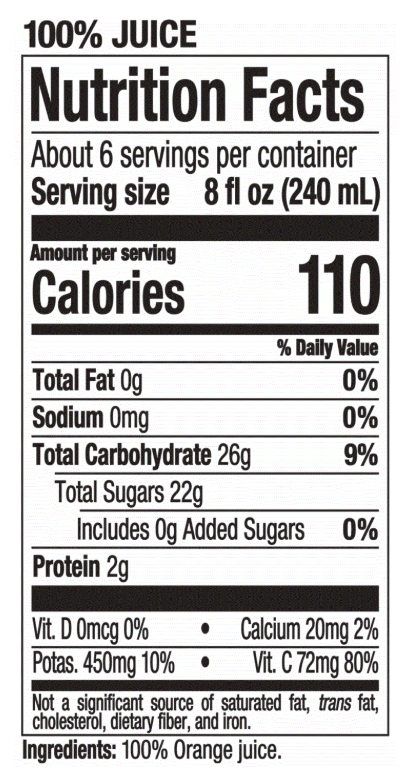
*Nutrition label shown for illustration. Be sure to check the label on your favorite 100% orange juice.
Is the sugar in orange juice the same as the sugar in soda?
In short, no. The only sugar in 100% orange juice is what’s naturally present in oranges. By contrast, sugar-sweetened beverages like soda are usually made with high fructose corn syrup (HFCS) or added table sugar.
While sugar content often gets the spotlight, it’s important to recognize that 100% orange juice is also a natural source of vitamins, minerals and beneficial plant compounds.
Will orange juice raise blood sugar?
Like all carbohydrate-containing foods, orange juice can affect blood sugar. However, because it has a low-to-moderate glycemic index (around 48 on average, ranging from 40-60), it is less likely to cause a significant spike in blood sugar levels.
Orange juice also includes hesperidin, a plant compound with antioxidant-like properties that may help regulate the body’s blood sugar response. Research suggests hesperidin can play a role in moderating blood sugar after meals. That means orange juice — thanks to its hesperidin — may not contribute to increases in blood sugar after a meal in the same way beverages with added sugar do.
How does orange juice compare with other fruit juices?
One key difference is hesperidin, the plant compound mentioned above, which is most abundantly found in citrus. Studies show that hesperidin has antioxidant effects and may help slow down the absorption of sugar, helping to regulate blood sugar levels after a meal.
Another distinction of 100% orange juice is its fructose-to-glucose ratio — in other words, how much fructose is paired with glucose. Recent studies show that orange juice has less unpaired fructose compared with other beverages (such as sugar-sweetened beverages and some 100% fruit juices). This balance may make it easier for your body to absorb these sugars, which can reduce digestive discomfort. In contrast, drinks with more unpaired fructose can lead to something called fructose malabsorption, where the body has a harder time absorbing the sugar.
Whether you prefer the taste of orange juice or another juice, it’s always important to check the label and make sure it’s 100% fruit juice with no added sugar. Other 100% fruit juices have different polyphenols with various health benefits.
Is orange juice healthy with how much sugar it contains?
Yes, 100% orange juice is healthy. It is naturally nutrient-dense, delivering vitamins, minerals and phytonutrients with no added sugar, sodium or saturated fat. Under the FDA definition, it qualifies as a “healthy” food.
Key nutrients include:
- Vitamin C which supports immune health and antioxidant activity and may help lessen stress on the body’s defense system and inflammation.
- Bioactive compounds (like hesperidin) are unique to citrus and linked to heart health, brain health and immune health.
- Potassium is essential for heart, kidney and muscle function.
- Folate is important for pregnancy health and cardiovascular support.
Beyond nutrients, research shows that adults and children who drink 100% orange juice tend to have higher diet quality and greater intake of vitamins, minerals and whole fruit. In other words, orange juice can be a valuable complement to whole fruit.
Plus, orange juice is nearly 90% water with electrolytes, making it a natural hydration option. A clinical study even found it hydrates as effectively as water or a sports drink after exercise.
What are “empty” calories? How does orange juice stack up, nutritionally?
The term “empty calories” describes foods and beverages that provide calories but with little to no nutritional value because they lack important vitamins and minerals. That’s the opposite of 100% orange juice.
Orange juice has a range of nutrients and bioactive compounds, including vitamin C, potassium, folate and hesperidin. It’s a nutrient-dense choice that contributes meaningful nutrition to the diet.
Sticking to the science
With so much conversation about sugar and its impact on health, it’s important to look at the facts. Backed by scientific evidence, 100% orange juice is a nutrient-dense beverage with no added sugar. It offers hydration support, vitamins, minerals and unique plant compounds that support health in a variety of ways.
As new research and insights emerge, Florida Citrus will continue to track developments and share clear, science-based updates. We invite you to check back often for the latest information!